
martes, 26 de junio de 2012

viernes, 22 de junio de 2012

miércoles, 20 de junio de 2012
Film cameras are ghetto
Bought a good camera, lost it, start using my parents' film camera and now I'm stuck with 4-5 undeveloped films... So guess what I'm doing today? Aaaahhhhh yeeeaaaahhhh!!!! And I'm extra excited because first, I forgot where I was when I was taking these pictures, and second, there's a lomogrophy film in there... So yeah, I know you're excited; like really really excited, so I'll post some soon.
Hasta tomorrow amigos
Hasta tomorrow amigos
martes, 19 de junio de 2012
lunes, 18 de junio de 2012
Procrastination - Level: expert
You have a lot of things to do but you decide to go on your computer instead because you're just that cool... What to do; facebook? Fuck that! Here is my top 5 websites to procrastinate.
5. twitter.com
Classic social media. You get news from people that you know, but also people that you've never met but are incredibly funny/interesting; don't really need to explain it more than that.
4. thesartorialist.blogspot.com
Selected as one of Time magazine's top 100 design influencers, Scott Schuman created this blog after leaving his job. He was taking pictures of people he saw whose style he found striking. So if you like fashion, or just a lot of inspiring pictures, check it out.
3. goodmusic-blog.com
This is Kanye's blog, he does a lot of showing off and advertising for G.O.O.D music, but if you like Ye, Big Sean, Kid Cudi, Pusha-T and the whole crew, who the hell cares. A lot of pictures and videos full of swag.
2. r-e-l-i-c.com
This is a really pointless one, but as an artist, it always seems to inspire me. This one is actually only pictures, no words, no titles, just fun inspiring images.
1. thefancy.com
Like pinterest, but way cooler. Awesome personalities from all over the world post pictures of new designs for everything from mugs to bicycle to pillows. A hipster heaven invented by capitalism, they also have the direct link to where you can by the new object of your dreams; and the best of all, they often have discounts so you'll only have to pay 50$ for that pair of channel socks.
So here you have it kiddos... Now GO PROCRASTINATE GO!!!
5. twitter.com
Classic social media. You get news from people that you know, but also people that you've never met but are incredibly funny/interesting; don't really need to explain it more than that.
4. thesartorialist.blogspot.com
Selected as one of Time magazine's top 100 design influencers, Scott Schuman created this blog after leaving his job. He was taking pictures of people he saw whose style he found striking. So if you like fashion, or just a lot of inspiring pictures, check it out.
3. goodmusic-blog.com
This is Kanye's blog, he does a lot of showing off and advertising for G.O.O.D music, but if you like Ye, Big Sean, Kid Cudi, Pusha-T and the whole crew, who the hell cares. A lot of pictures and videos full of swag.
2. r-e-l-i-c.com
This is a really pointless one, but as an artist, it always seems to inspire me. This one is actually only pictures, no words, no titles, just fun inspiring images.
1. thefancy.com
Like pinterest, but way cooler. Awesome personalities from all over the world post pictures of new designs for everything from mugs to bicycle to pillows. A hipster heaven invented by capitalism, they also have the direct link to where you can by the new object of your dreams; and the best of all, they often have discounts so you'll only have to pay 50$ for that pair of channel socks.
So here you have it kiddos... Now GO PROCRASTINATE GO!!!
sábado, 16 de junio de 2012
viernes, 15 de junio de 2012
Top 3 favourite sculptor
So like I told you in the first post of gumption 2.0, I fell in love with sculpture this year. When we have art classes in high school, we mostly see painters, so this new world was really a revelation for me.
So here is my top three favourite sculptors.
3. Naum Gabo
 Russian sculptor; he was one of the first to do constructions instead of sculptures. He did not mold or carve but built, which permitted him to create things which were impossible before (you couln't mold or carve the sculpture on the right). With all these new possibilities, he was able to use empty spaces as a part of his sculpture (ex: all the spaces between the metal rods) and with that, he discovered that volumes of space itself was sculptable, not only volumes of mass.
He also sculpted time in his pieces. By having a rythm that would unite every part of his sculpture, he was able to introduce the 4th dimension; one that has never been mastured as well since.
2. Constantin Brancusi

Opposed Gabo, he was a 'classic' sculptor. He was the student of Auguste Rodin (the thinker), but he decided to leave the workshop of his master so he could become the master he is today.
Brancusi wasn't an abstract sculptor, he created things that really existed; however he wasn't representing it in its figurative way, he was only representing the essential. For exemple, the sculpture on the right is a bird, but it represents the freedom, the lightness and the mouvement of one.
1. Damien Hirst
 He is way more modern than the other 2 and he also does a different type of sculpture. Instead of using raw materials, he uses things that are already made (it's a real shark on the right). He is a modern/conceptual artist, which means that the concept behind the sculpture is more important than the sculpture itself.
He works with the concept of death and life, examining the moments where both life and death are presents and ou living relationship with death (the piece on the right is called the physical impossibility of death inside the mind of someone living).
This post isn't supposed to be an extensive essay about those three sculptors, I just wanted to present you my fav 3. If you would like to know more, there are a lot of books out there. My favourite one is a little about Damien Hirst but mostly about contemporary art; and it's called 'The $12 Million Stuffed Shark'.
So here is my top three favourite sculptors.
3. Naum Gabo
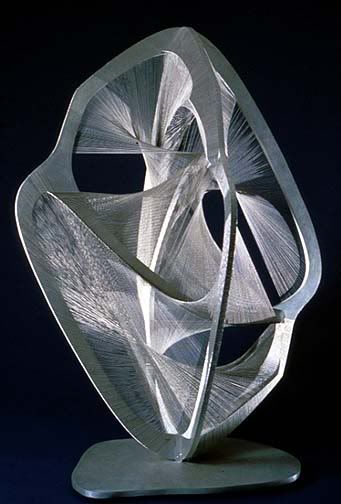 Russian sculptor; he was one of the first to do constructions instead of sculptures. He did not mold or carve but built, which permitted him to create things which were impossible before (you couln't mold or carve the sculpture on the right). With all these new possibilities, he was able to use empty spaces as a part of his sculpture (ex: all the spaces between the metal rods) and with that, he discovered that volumes of space itself was sculptable, not only volumes of mass.
He also sculpted time in his pieces. By having a rythm that would unite every part of his sculpture, he was able to introduce the 4th dimension; one that has never been mastured as well since.
2. Constantin Brancusi

Opposed Gabo, he was a 'classic' sculptor. He was the student of Auguste Rodin (the thinker), but he decided to leave the workshop of his master so he could become the master he is today.
Brancusi wasn't an abstract sculptor, he created things that really existed; however he wasn't representing it in its figurative way, he was only representing the essential. For exemple, the sculpture on the right is a bird, but it represents the freedom, the lightness and the mouvement of one.
1. Damien Hirst

He works with the concept of death and life, examining the moments where both life and death are presents and ou living relationship with death (the piece on the right is called the physical impossibility of death inside the mind of someone living).
This post isn't supposed to be an extensive essay about those three sculptors, I just wanted to present you my fav 3. If you would like to know more, there are a lot of books out there. My favourite one is a little about Damien Hirst but mostly about contemporary art; and it's called 'The $12 Million Stuffed Shark'.
jueves, 14 de junio de 2012
miércoles, 13 de junio de 2012
The opinion on...open mindedness
The first 'The opinion on...' for gumption 2.0! Aren't we excited...
I want to talk about a cliché concept that isn't really what it should be. Having an open mind is something that's obviously necessary, but the way it's been explained to me, there's something missing. It's current definition would be something like 'being receptive to new and different ideas or the opinions of others' (definition from thefreedictionary.com). The problem is, what happen when another culture doesn't let women vote, or kill people without a fair trial; should we be open minded about these ideas? We aren't open minded about these things, because it's impossible (and not very practical) to be open minded about things that are actually different from ours. We're open minded about things that are already acceptable, like eating bugs, or having a different religion, or having 10 kids. We accept these things sayng we are open minded, but actually, it's because these things are not very different from our one culture.
The way I see it, we should ask ourselves to be open minded not about what other people do, but about ourselves.
Imagine if we would be attacked by someone else because are way of life isn't acceptable. Could we live with that? Would we be open minded about that idea?
I feel like it's natural and we have the right to say 'wow, this other culture is weird' or 'what their doing is unacceptable', but with that comes the responsability to honestly (and let me put some emphasis on the honestly) accept that we are also the weird ones.
When you say 'what this culture is doing is unacceptable', you have to know that you're way of doing it is as unacceptable because weirdness is always reciprocal. Only then can you really respect someone elses ideas, and only then can you really understand someone elses point of view. And only then can you really ask each other; is there a way that's better than the other?
I want to talk about a cliché concept that isn't really what it should be. Having an open mind is something that's obviously necessary, but the way it's been explained to me, there's something missing. It's current definition would be something like 'being receptive to new and different ideas or the opinions of others' (definition from thefreedictionary.com). The problem is, what happen when another culture doesn't let women vote, or kill people without a fair trial; should we be open minded about these ideas? We aren't open minded about these things, because it's impossible (and not very practical) to be open minded about things that are actually different from ours. We're open minded about things that are already acceptable, like eating bugs, or having a different religion, or having 10 kids. We accept these things sayng we are open minded, but actually, it's because these things are not very different from our one culture.
The way I see it, we should ask ourselves to be open minded not about what other people do, but about ourselves.
Imagine if we would be attacked by someone else because are way of life isn't acceptable. Could we live with that? Would we be open minded about that idea?
I feel like it's natural and we have the right to say 'wow, this other culture is weird' or 'what their doing is unacceptable', but with that comes the responsability to honestly (and let me put some emphasis on the honestly) accept that we are also the weird ones.
When you say 'what this culture is doing is unacceptable', you have to know that you're way of doing it is as unacceptable because weirdness is always reciprocal. Only then can you really respect someone elses ideas, and only then can you really understand someone elses point of view. And only then can you really ask each other; is there a way that's better than the other?
martes, 12 de junio de 2012

lunes, 11 de junio de 2012
Last year in a 140 characters
Went to university, fell in love with sculpture, quantum physics and philosophy, got accepted in architecture in Laval, missed mexico, lived
WE BACK!!!
I'm back, and just in time for the summer.
I haven't posted anything in a while (read 10 months) and I have decided that's it's time to get back at it.
Three things brought me to the same conclusion, which is pretty much YOLO baybay!!! (or hakuna mata if you're a 90's kid, or carpe diem if you're a pre 18th century kid and you can actually understand latin)
First, I started working as a janitor in a hosptial (please don't judge me on that one, it's only for the summer)... So I always see people dying, which reminds me, I'll probably die too.
Second, for the first time in my life; someone my age that I knew died, which also reminded me; damn, this whole death thing can happen pretty quickly.
Last but not least, my sister told something pretty cheesy/true. She said "you know you've gotten old when your memories are more important then your dreams''.
In a nutshell, I asked myself "What could I do right now that in 10 years I would say, 'Man, I was doing stuff back then'."
So here it is... "Your mission, if you choose to accept it, is to post something every day for the rest of the summer"
It's going to be pretty similar as what I was posting back in the Mexico days (for the ones who just started following, this blog started when I left for Mexico for a year in the summer of 2010). So there'll be random posts, pictures, music and "the opinion on..." I know I'll get myself in trouble for some of them but hey, if you write the same opinion that everybody elses have, you pretty much become a news paper.
I'll see you tomorrow captains! Oh and by the way, thanks for the 5000th view!
I haven't posted anything in a while (read 10 months) and I have decided that's it's time to get back at it.
Three things brought me to the same conclusion, which is pretty much YOLO baybay!!! (or hakuna mata if you're a 90's kid, or carpe diem if you're a pre 18th century kid and you can actually understand latin)
First, I started working as a janitor in a hosptial (please don't judge me on that one, it's only for the summer)... So I always see people dying, which reminds me, I'll probably die too.
Second, for the first time in my life; someone my age that I knew died, which also reminded me; damn, this whole death thing can happen pretty quickly.
Last but not least, my sister told something pretty cheesy/true. She said "you know you've gotten old when your memories are more important then your dreams''.
In a nutshell, I asked myself "What could I do right now that in 10 years I would say, 'Man, I was doing stuff back then'."
So here it is... "Your mission, if you choose to accept it, is to post something every day for the rest of the summer"
It's going to be pretty similar as what I was posting back in the Mexico days (for the ones who just started following, this blog started when I left for Mexico for a year in the summer of 2010). So there'll be random posts, pictures, music and "the opinion on..." I know I'll get myself in trouble for some of them but hey, if you write the same opinion that everybody elses have, you pretty much become a news paper.
I'll see you tomorrow captains! Oh and by the way, thanks for the 5000th view!
miércoles, 2 de noviembre de 2011
EUREKA!!!!
That's what Lila wanted to say when she screamed at the captain 'I'm wathever the fuck you want me to be'. She was saying that: whatever he sees of her, is whatever he will think of her, and after a while that's what she will become (how can you ever be something else then what someone else thinks of you, because you only exist when someone else thinks of you). The next step is the scary one; when the idea of what she 'is' becomes so inscribed inside the mind of the captain, he wont be able to see anything else then what he knows she is (because he thinks that he knows what she is, so in this case, thinking something and knowing something is the exact same), she will therefore stay 'whatever the fuck he wants him to be' for the rest of her life. And that's what kills the dynamic beauty.
lunes, 24 de octubre de 2011
Sailing, philosophy, sex and madness
That is how my second favorite book*, is described by the New York Times... And that's kind of how I want my life to be described to. Is it set in stone if I put on my blog what my life goal is? Well whatever, my life goal is to buy a sail boat, and go from japan to new zeland, with my wife... and a cat.
It's technically my first because if I put Lila and ZAMM together. I still don't know wich one I like the most though.
It's technically my first because if I put Lila and ZAMM together. I still don't know wich one I like the most though.
jueves, 20 de octubre de 2011
Inside job
Here is an extra reason why I have to be an architect.
Since Plato's time, art has always been on a lower level then sciences, it was there to satisfy an "inferior" human need. An we still see that idea today, and believe it or not, the art students are probably the ones telling those idiots that they are right. I might sound weird at first, but if you think about it, if somebody is good in both, he'll be encouraged by most to go in the science direction, and most of the time, an art student is only someone that didn't understand science. We are the ones that "couldn't do it", "ooohhhh, you don't like math", says the theacher, "well maybe you should do biology", "oooh, you don't understand that either? Well I guess your only option left is art".
And this is where architecture arrives.
Science doesn't see it as an outsider, because it speaks its language. It speaks in laws and equations, so science blindfully falls in love with it, saying that what he does is (scientifically beautiful). Well I guess that explains why science loved the building at first, but why does it fall in love with it every day? That he can't explain with laws an equations. Inside job.
They speak the same language, but they don't talk about the same thing. One talks about a world it invented (science), and the other one talks about a world that doesn't exist (art). The architect is doing the translation for both of them.
Architecture is such a wonderful world because it is perfectly balanced between static paterns (science) and dynamic paterns (art). That's what I want to do for the rest of my life, getting paid to do relax on the line between insanity and reality. Colorful chaos and symetrical stability.
Since Plato's time, art has always been on a lower level then sciences, it was there to satisfy an "inferior" human need. An we still see that idea today, and believe it or not, the art students are probably the ones telling those idiots that they are right. I might sound weird at first, but if you think about it, if somebody is good in both, he'll be encouraged by most to go in the science direction, and most of the time, an art student is only someone that didn't understand science. We are the ones that "couldn't do it", "ooohhhh, you don't like math", says the theacher, "well maybe you should do biology", "oooh, you don't understand that either? Well I guess your only option left is art".
And this is where architecture arrives.
Science doesn't see it as an outsider, because it speaks its language. It speaks in laws and equations, so science blindfully falls in love with it, saying that what he does is (scientifically beautiful). Well I guess that explains why science loved the building at first, but why does it fall in love with it every day? That he can't explain with laws an equations. Inside job.
They speak the same language, but they don't talk about the same thing. One talks about a world it invented (science), and the other one talks about a world that doesn't exist (art). The architect is doing the translation for both of them.
Architecture is such a wonderful world because it is perfectly balanced between static paterns (science) and dynamic paterns (art). That's what I want to do for the rest of my life, getting paid to do relax on the line between insanity and reality. Colorful chaos and symetrical stability.
jueves, 29 de septiembre de 2011
the opinion on... beauty
Easy subject, said hippias major; however Socrates answered "yes, i know, but...", and that's where it all started. The philosophy behind beauty. What IS beauty? What makes us all agree that something is good or not but at the same time makes us argue for hours about what's better, does it lay in the object, or in the observer? Is there a definition? If not, why do we even talk about it?
I would first like to start with two arguments from my favorite author, Robert M. Pirsig, first we'll talk about if beauty actually exists, and second we'll ask ourselves if it is in the object or the observer.
In ZAMM, Pirsig proves that beauty exists by substituting it from our reality and then showing how absurd that world would be (remember, for Pirsig, beauty is equal to quality and value). He first talks about the obvious field that would be affected, art. A world of art without beauty is indescribable, just non-existing, so that one is easy. But then he talks about other fields (unsuspected ones at first) that would be affected by the substitution of beauty. Mathematicians, for example, would not be able to make the difference between a well applied equations and one that is not because the value of something well made wouldn't exist. Why should they say that 2+2=4 if there is no right or wrong. We can also think about sports that wouldn't have any more way to decide what is worth a point or what is worth a penalty, because the value of something wouldn't exist anymore.
After a while, we start noticing that even though we haven't described beauty yet, it is impossible to imagine a world without it.
Now let's see Pirsig's answer on a question that is still being asked today (probably because Pirsig is still not accepted in the world of philosophy, but I think that his metaphysics is the better one). Pirsig's answer on the question ''is beauty subjective or objective??", is neither of them, beauty is the father of the subject and the object. Pretty weird eh?. It took me a while to understand that one but I think the best example is in Lila: an inquiry into morals.
If somebody sits on a hot stove (which doesn't have a lot of value/quality/beauty), it wont take a long time for him to jump off. And that philosophically means that without the low quality of the hot stove, there wouldn't be a stove, neither somebody being burned, in the first place. He is saying that without a connection between an object and a subject, there is no object nor subject, and that connection could be described as quality/beauty.
So the whole problem with the question "is beauty subjective or objective", is actually the question itself, not the lack of answer.
You can also explain this by a famous rethorical question. If a tree falls in the wood and nobody is there to hear it, does it make noise. No, because noise needs someone to make it and some one to hear it, for it to be noise. And in this case, noise is the connection between the tree and the person hearing it.
Now let's try the worst part of this big bad wolf of philosophy, what is beauty? In this part I'll do like hippias and just throw a few ideas out there.
1. The description of beauty a long time ago was how well can you imitate something, a tree, a person etc... however, when photography was discovered, every other art lost his job, but beauty still exists today no? So what happened?
Well I think the description is good, the problem is that when we say imitating we automatically think about an object, but there's also the imitation of a feeling.
Example: If you compare a picture of a tree with a Monet of a tree, the picture obviously looks more like a tree, however, it's not as alive as the Monet. In a painting, or whatever type of art, we don't only imitate the object, but also the feeling we get with that object.
And that explains a lot of things. Abstract art is appreciated because it can describe more then one feeling at the same type, there's more room for some to look at it and say "that's exactly how I feel", and like I've heard before, the deepest psychologically need of a human is to be understood, that's what we all want.
It also explains why scary movies and sad plays are as appreciated as a nostalgic painting, is that every feelings are as close to beauty as the other. If a play describes perfectly how we felt at a moment in our life, it's beautiful.
So attempt #1 is, beauty is imitation (of a feeling or an object)
2. I've also thought that maybe we're looking for a description that explains more then one thing at the same time. Like I said before, before photography was discovered, or that individuality wasn't accepted, the description of beauty was easier. Why? well because there was only one type of beauty. Now everything can be art, from a toilet turned upside down to a tiger shark in an aquarium. Maybe we should separate a few groups in there (not by types of art but by types of beauty). That doesn't mean that they wont be described approximately in the same way, it just means that a small exception in one type of beauty wont screw up the description for the rest of the beauties that are listening to the rules.
The point is, sometime we are so stuck on trying to find an answer to a question that is wrong in the beginning, and that's what I love so much about this problem. People don't really have that mental reflex but we should, "If there's been a question unanswered for centuries, well maybe the question is impossible, not the answer".
And that lack of mental awareness is most beautifully observable in people that are stuck in the small world that they have been studying all there lives. When those people disconnect with reality, they can't even look at something from an other point of view to see that the problem is not even between the question and the answer, it's way more fundamental then that.
I love philosophy because (even though it sounds weird) it empties my mind and fills my heart, it's just something that you have to do in such a romantic way, that you forget you're trying to figure out the world. Maybe being naive is not so wrong in the first place.
I would first like to start with two arguments from my favorite author, Robert M. Pirsig, first we'll talk about if beauty actually exists, and second we'll ask ourselves if it is in the object or the observer.
In ZAMM, Pirsig proves that beauty exists by substituting it from our reality and then showing how absurd that world would be (remember, for Pirsig, beauty is equal to quality and value). He first talks about the obvious field that would be affected, art. A world of art without beauty is indescribable, just non-existing, so that one is easy. But then he talks about other fields (unsuspected ones at first) that would be affected by the substitution of beauty. Mathematicians, for example, would not be able to make the difference between a well applied equations and one that is not because the value of something well made wouldn't exist. Why should they say that 2+2=4 if there is no right or wrong. We can also think about sports that wouldn't have any more way to decide what is worth a point or what is worth a penalty, because the value of something wouldn't exist anymore.
After a while, we start noticing that even though we haven't described beauty yet, it is impossible to imagine a world without it.
Now let's see Pirsig's answer on a question that is still being asked today (probably because Pirsig is still not accepted in the world of philosophy, but I think that his metaphysics is the better one). Pirsig's answer on the question ''is beauty subjective or objective??", is neither of them, beauty is the father of the subject and the object. Pretty weird eh?. It took me a while to understand that one but I think the best example is in Lila: an inquiry into morals.
If somebody sits on a hot stove (which doesn't have a lot of value/quality/beauty), it wont take a long time for him to jump off. And that philosophically means that without the low quality of the hot stove, there wouldn't be a stove, neither somebody being burned, in the first place. He is saying that without a connection between an object and a subject, there is no object nor subject, and that connection could be described as quality/beauty.
So the whole problem with the question "is beauty subjective or objective", is actually the question itself, not the lack of answer.
You can also explain this by a famous rethorical question. If a tree falls in the wood and nobody is there to hear it, does it make noise. No, because noise needs someone to make it and some one to hear it, for it to be noise. And in this case, noise is the connection between the tree and the person hearing it.
Now let's try the worst part of this big bad wolf of philosophy, what is beauty? In this part I'll do like hippias and just throw a few ideas out there.
1. The description of beauty a long time ago was how well can you imitate something, a tree, a person etc... however, when photography was discovered, every other art lost his job, but beauty still exists today no? So what happened?
Well I think the description is good, the problem is that when we say imitating we automatically think about an object, but there's also the imitation of a feeling.
Example: If you compare a picture of a tree with a Monet of a tree, the picture obviously looks more like a tree, however, it's not as alive as the Monet. In a painting, or whatever type of art, we don't only imitate the object, but also the feeling we get with that object.
And that explains a lot of things. Abstract art is appreciated because it can describe more then one feeling at the same type, there's more room for some to look at it and say "that's exactly how I feel", and like I've heard before, the deepest psychologically need of a human is to be understood, that's what we all want.
It also explains why scary movies and sad plays are as appreciated as a nostalgic painting, is that every feelings are as close to beauty as the other. If a play describes perfectly how we felt at a moment in our life, it's beautiful.
So attempt #1 is, beauty is imitation (of a feeling or an object)
2. I've also thought that maybe we're looking for a description that explains more then one thing at the same time. Like I said before, before photography was discovered, or that individuality wasn't accepted, the description of beauty was easier. Why? well because there was only one type of beauty. Now everything can be art, from a toilet turned upside down to a tiger shark in an aquarium. Maybe we should separate a few groups in there (not by types of art but by types of beauty). That doesn't mean that they wont be described approximately in the same way, it just means that a small exception in one type of beauty wont screw up the description for the rest of the beauties that are listening to the rules.
The point is, sometime we are so stuck on trying to find an answer to a question that is wrong in the beginning, and that's what I love so much about this problem. People don't really have that mental reflex but we should, "If there's been a question unanswered for centuries, well maybe the question is impossible, not the answer".
And that lack of mental awareness is most beautifully observable in people that are stuck in the small world that they have been studying all there lives. When those people disconnect with reality, they can't even look at something from an other point of view to see that the problem is not even between the question and the answer, it's way more fundamental then that.
I love philosophy because (even though it sounds weird) it empties my mind and fills my heart, it's just something that you have to do in such a romantic way, that you forget you're trying to figure out the world. Maybe being naive is not so wrong in the first place.
lunes, 26 de septiembre de 2011
HOLY SHIT!!!!
Oh my god, my worst fear is becoming reality.
A while ago I asked if something is completely worthless for someone, does it have to be worthless for you? The answer I ended up finding is no, but it's pretty damn hard to keep the value that it has for you, personally.
And that is exactly what happened to me with my Mexico experience. It has now become a memory, and this can be really bad or really good.
Bad because it means that it's over, done, kaput; but good become now I can look at it from a distance, remember it and smile. And it's in that step that I became lazy, I stopped thinking about my experience. Why? well because it hurts, because I got better things to do then remember and I just simply don't want to feel nostalgic.
It's at that moment that my best friend made me notice that it has to hurts, you have to remember and nostalgia is not such a bad thing. You see, you can't always be going to a higher level that where you are now, you can't always be working towards something better, because if you do, well you're always leaving something behind, and sometimes leaving that thing behind stops you from going forward; that's what was happening to me. I forgot about every body that was there for me for a year, every one that made that small effort to make me who I am today.
Sometime I'm just so scare to feel something that might no lead to happiness, that I stop myself from going through the steps that bring me to it. I guess what I do with love is the same thing that I do with nostalgia.
So let me say that I am sorry that I turned into a snobby person for a few months, I just didn't have the energy to miss Mexico.
But I've noticed that even though remembering Mexico hurts, forgetting it is suicidal.
A while ago I asked if something is completely worthless for someone, does it have to be worthless for you? The answer I ended up finding is no, but it's pretty damn hard to keep the value that it has for you, personally.
And that is exactly what happened to me with my Mexico experience. It has now become a memory, and this can be really bad or really good.
Bad because it means that it's over, done, kaput; but good become now I can look at it from a distance, remember it and smile. And it's in that step that I became lazy, I stopped thinking about my experience. Why? well because it hurts, because I got better things to do then remember and I just simply don't want to feel nostalgic.
It's at that moment that my best friend made me notice that it has to hurts, you have to remember and nostalgia is not such a bad thing. You see, you can't always be going to a higher level that where you are now, you can't always be working towards something better, because if you do, well you're always leaving something behind, and sometimes leaving that thing behind stops you from going forward; that's what was happening to me. I forgot about every body that was there for me for a year, every one that made that small effort to make me who I am today.
Sometime I'm just so scare to feel something that might no lead to happiness, that I stop myself from going through the steps that bring me to it. I guess what I do with love is the same thing that I do with nostalgia.
So let me say that I am sorry that I turned into a snobby person for a few months, I just didn't have the energy to miss Mexico.
But I've noticed that even though remembering Mexico hurts, forgetting it is suicidal.
sábado, 3 de septiembre de 2011
The opinion on... generalization
"All animals are equal, but some animals are more equal then other"
Well that's a cheesy way to start a post. Quotes sucks, I hate them, but they're a pretty trendy way to start an article, and all you cliche artsy people out there love them, so why not.
Talking about cliche, I've been hearing people getting mad at me for using my favorite weapon in the whole world of rhetoric; generalization. They're only way of attacking me is telling me "you can't stereotype like that because everyone is unique". Well that sucks, how do you want me to say anything else after that? They just used the most basic fact of sociology, everyone is different.
But that argument, even though amazingly accurate, doesn't mean that stereotyping is wrong.
So first let me tell you why we need stereotyping.
Stereotyping is necessary in our world because, as a human race, we want to figure out some stuff. We want everything to be cause and effect, and that's why stereotypes are so hated on, because humans are dynamics, hens cause and effects don't work as well as other sciences. However that doesn't mean we can't try it.
Look, let's say that 80% of the people that study sociology are voting liberal, saying that 80% of sociologist are liberal is to long and complicated, and not saying anything (because you can't really say anything, cause not all sociologist are liberal) is pretty boring and completely pointless, like I already said, saying that everybody is unique his nothing unheard of. So what is the last thing you can say about sociologist is that they are liberal. Yeah, 20% of the time I'll be wrong, but at least I said something that can evolve to a higher thought, and that is what us, as humans want.
But now, let me tell you something, I am not completely retarded, I know that there are good and bad stereotypes. So where is the line? Simple, the line between a charasterictic of someone that you can stereotype, or make a higher value judgement of, is between the charasteristic that that person choose, and the ones that are forced on him/her. Ex, you can't judge someone on the color of his skin, his economical situation that he was borned in (when he is older, that is a little different because the decision he made are the one influencing his paycheck, actually, economists think that if you average the salary of your 4 best friends, it's pretty close to yours). However, you can completely judge someone on the stuff he chooses (his job, does he have kids, size of his house/car) because in the end, generalization is the root of logic.
So here it is, the opinion on generalization. The fastest way to the truth.
Well that's a cheesy way to start a post. Quotes sucks, I hate them, but they're a pretty trendy way to start an article, and all you cliche artsy people out there love them, so why not.
Talking about cliche, I've been hearing people getting mad at me for using my favorite weapon in the whole world of rhetoric; generalization. They're only way of attacking me is telling me "you can't stereotype like that because everyone is unique". Well that sucks, how do you want me to say anything else after that? They just used the most basic fact of sociology, everyone is different.
But that argument, even though amazingly accurate, doesn't mean that stereotyping is wrong.
So first let me tell you why we need stereotyping.
Stereotyping is necessary in our world because, as a human race, we want to figure out some stuff. We want everything to be cause and effect, and that's why stereotypes are so hated on, because humans are dynamics, hens cause and effects don't work as well as other sciences. However that doesn't mean we can't try it.
Look, let's say that 80% of the people that study sociology are voting liberal, saying that 80% of sociologist are liberal is to long and complicated, and not saying anything (because you can't really say anything, cause not all sociologist are liberal) is pretty boring and completely pointless, like I already said, saying that everybody is unique his nothing unheard of. So what is the last thing you can say about sociologist is that they are liberal. Yeah, 20% of the time I'll be wrong, but at least I said something that can evolve to a higher thought, and that is what us, as humans want.
But now, let me tell you something, I am not completely retarded, I know that there are good and bad stereotypes. So where is the line? Simple, the line between a charasterictic of someone that you can stereotype, or make a higher value judgement of, is between the charasteristic that that person choose, and the ones that are forced on him/her. Ex, you can't judge someone on the color of his skin, his economical situation that he was borned in (when he is older, that is a little different because the decision he made are the one influencing his paycheck, actually, economists think that if you average the salary of your 4 best friends, it's pretty close to yours). However, you can completely judge someone on the stuff he chooses (his job, does he have kids, size of his house/car) because in the end, generalization is the root of logic.
So here it is, the opinion on generalization. The fastest way to the truth.
Suscribirse a:
Entradas (Atom)